
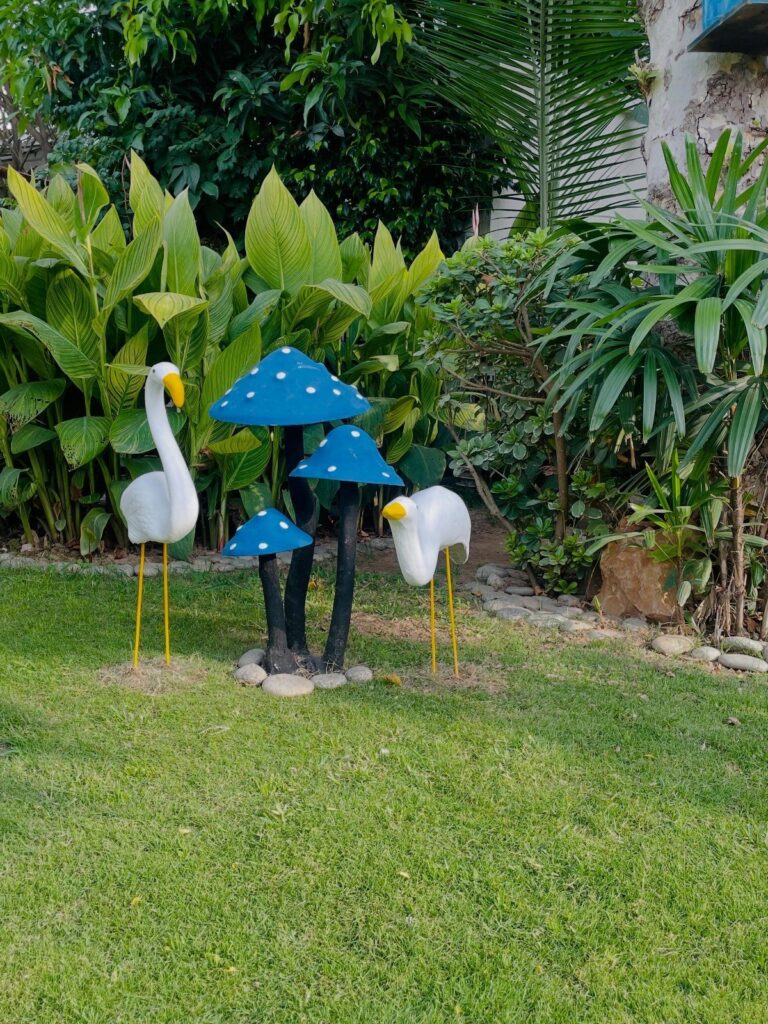
These 18 ideas run from a free pile of worn tractor tires to teak furniture that costs serious money, and from an afternoon of wiring mason jars to pouring concrete posts that need a full weekend.
Your starting point is not style or budget: it is whether you are fitting one weekend project into a rental yard you will leave, or building something permanent around a house you own.
The paver base I would use to level an outdoor dining table, for instance, stays behind when you move, but the hours leveling it are real either way.
[link-whisper-related-posts]1. Distinct Outdoor Dining Spaces

A dining space set apart from the lawn or seating area gets used more often because it feels intentional, not like an afterthought.
The pergola overhead defines the zone without walls; the water feature nearby adds sound that masks traffic. Before you copy this layout, check whether your yard has a flat spot large enough for a table plus chairs pulled out.
A slope across the span of a table will send plates sliding and make guests uneasy, so check with a level before you set up.
If your ground is uneven, a paver base takes a weekend to level and totals less than a store-bought patio kit.
I would start with the table placement and build outward; lighting and greenery fill in once you know where people actually sit.
There’s a reason the best dinner party you’ve ever been to was probably outside.
2. Striped Linens for Outdoor Dining
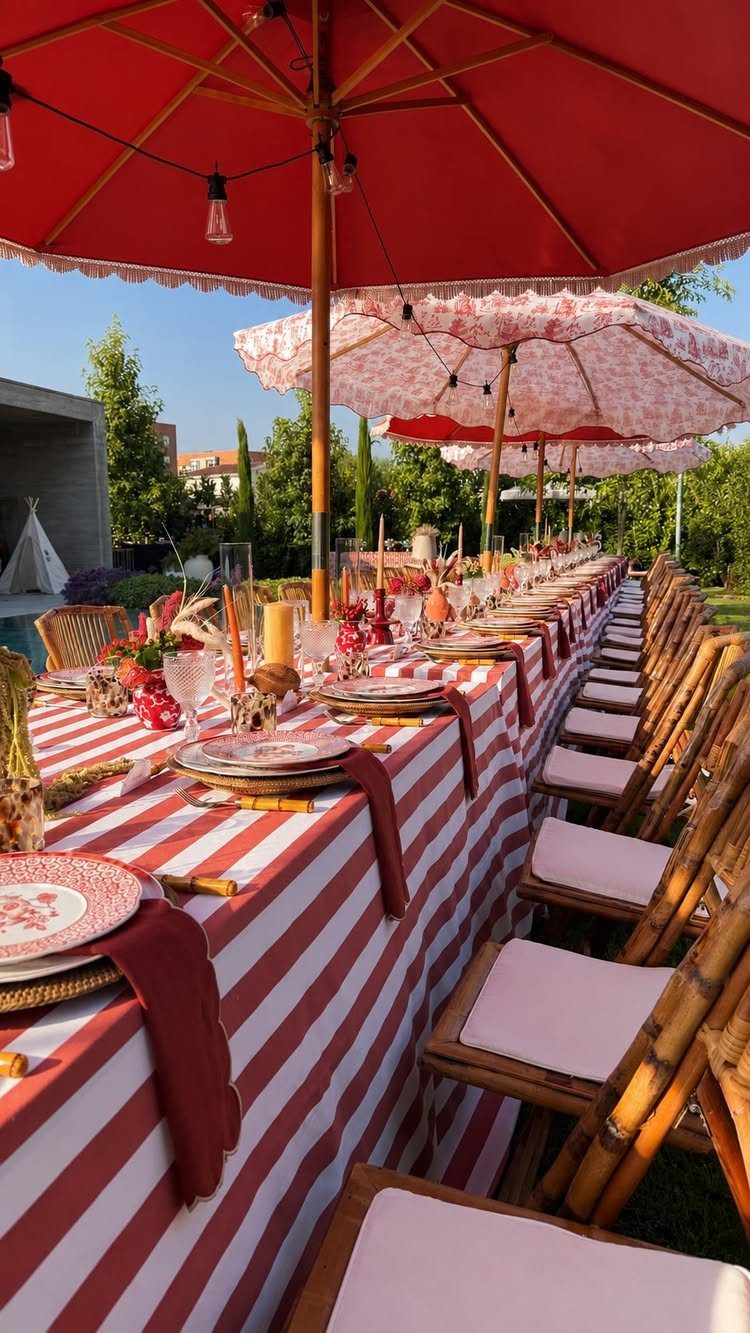
Striped linens read instantly as outdoor dining because the pattern carries from picnics and beach cabanas. Red and white against green foliage gives the highest contrast for the least money; navy and white stays cleaner between washes.
The fabric needs to be polyester or a poly-cotton blend, not pure cotton, or it will mildew within a week of summer humidity.
I would skip fitted covers and buy rectangular cloths I can throw in the wash, because outdoor tables vary and a too-tight fit looks like a mistake.
Bamboo chairs pair well with this look but need a covered spot or seasonal storage; they crack after 2 winters left out in rain or hard freeze.
3. Hanging Mason Jar Fairy Light Lanterns
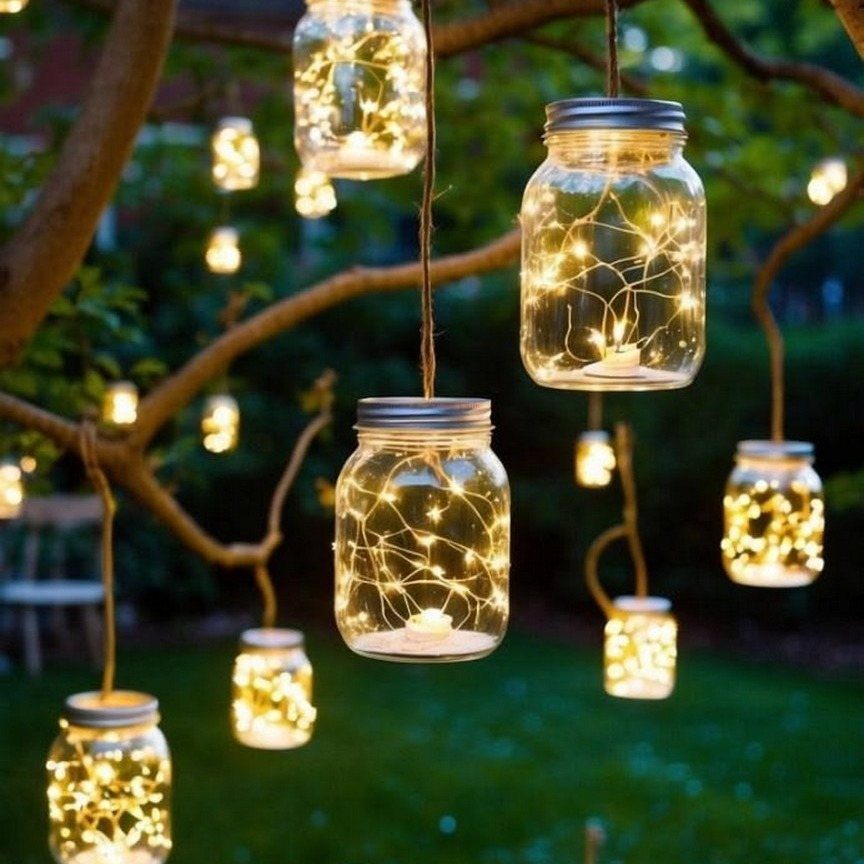
Mason jar lanterns run cheap if you already own jars, or you can buy them by the dozen at a hardware store for a few dollars each.
The light catch is wiring over twine for outdoor hangs; twine rots and eventually drops jars.
Battery fairy lights run a long evening on a set of AAs; solar ones save the trouble but dim after dark in most U.S. latitudes.
I would cluster jars at staggered heights rather than string them in a line, which reads as a boundary instead of a glow.
Check branch strength before you climb; a loaded jar weighs enough to matter, and wet material adds more after rain.
4. Plant a Cottage Garden
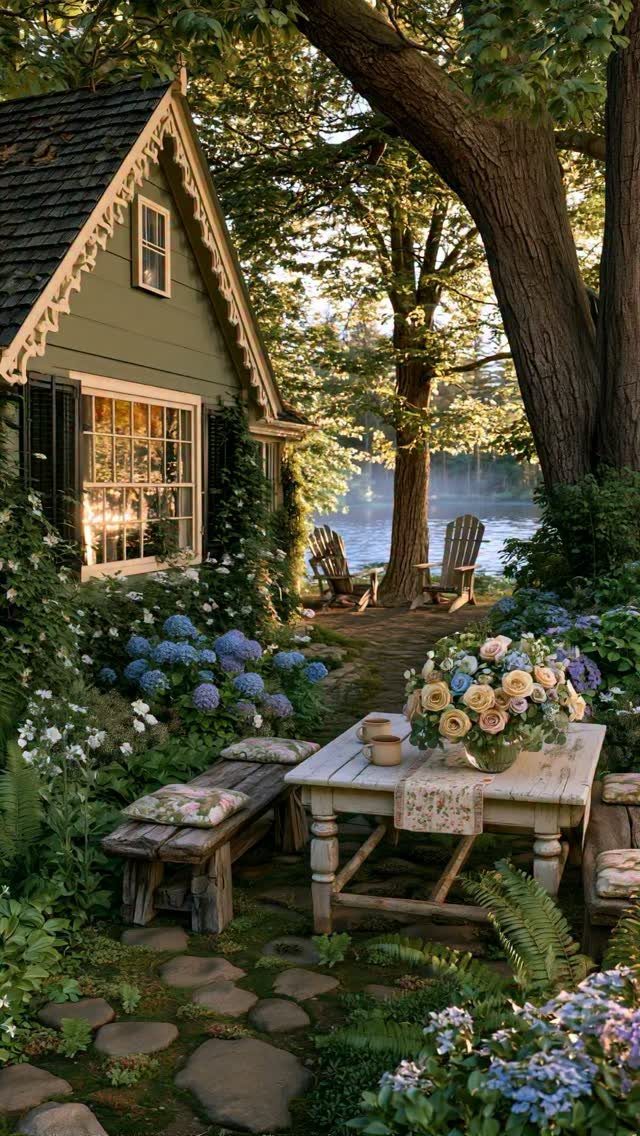
A cottage garden is the opposite of a planned bed; plants drift and self-seed until the whole yard looks slightly overgrown on purpose.
Hydrangeas give structure and bloom all summer in zones 4–9, which covers most of the country except the hottest parts of Texas and Florida.
I would plant them first, then fill gaps with annuals and self-seeders like zinnia and cleome, which run cheap by the seed packet.
Stone paths work better than pavers here because the edges blur into the planting; a straight line would fight the mood.
This style needs regular deadheading and editing through the season, or it becomes a mess by midsummer, not a romantic one.
5. Weathered Wood
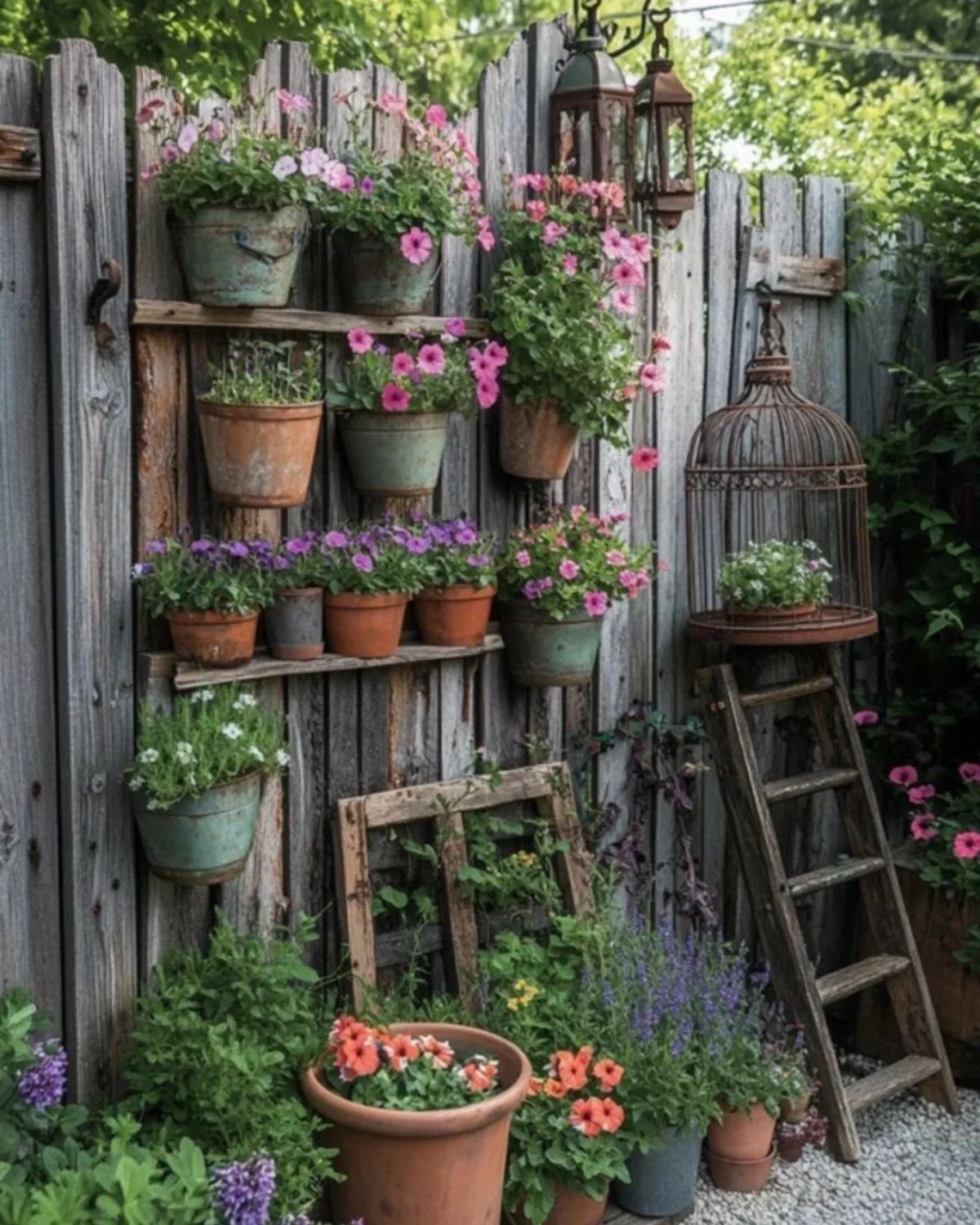
Weathered wood is a finish, not a type; any lumber left unsealed will gray within the year depending on sun and rain.
Cedar and redwood last longest because the tannins resist rot, but pine works if you budget to replace pieces when they soften.
Fence boards make solid display surfaces; I would anchor shelves with exterior-grade screws, not nails, because seasonal swelling pops nail heads. A steel brush speeds the graying if you are starting with new lumber and lack patience.
The birdcage is decorative only; if you want to attract birds, use a feeder with a wide landing platform and skip the rust, which can flake into seed.
6. Create a Garden Vignette
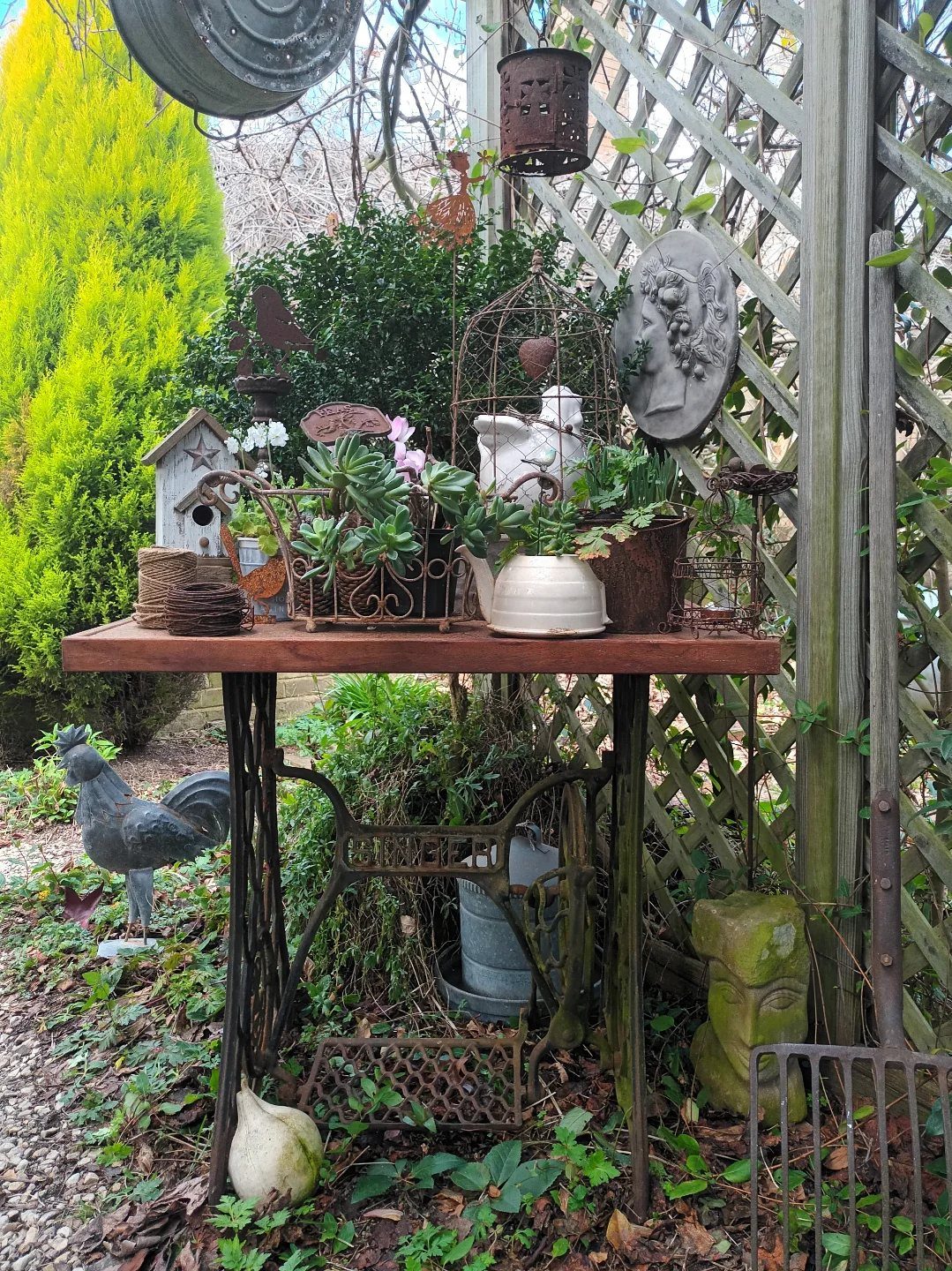
A vignette is a small arranged scene, and the garden version works because it gives the eye something to rest on between plantings.
The sewing-machine base is cast iron, which weighs enough to stay put in wind but rusts if the paint chips; I would sand and spray a fresh coat before it gets bad.
Succulents in pots need grit mixed into the soil, not potting mix alone, or they rot in humid summers.
I would place this against a wall or trellis, not floating in open lawn, because the backdrop makes the grouping read as deliberate.
I would stick to odd counts like three or five; even groupings read flat against a garden’s natural chaos. Even pairs look like a display at a garden center, waiting to be bought.
7. Hanging Teacup Bird Feeders
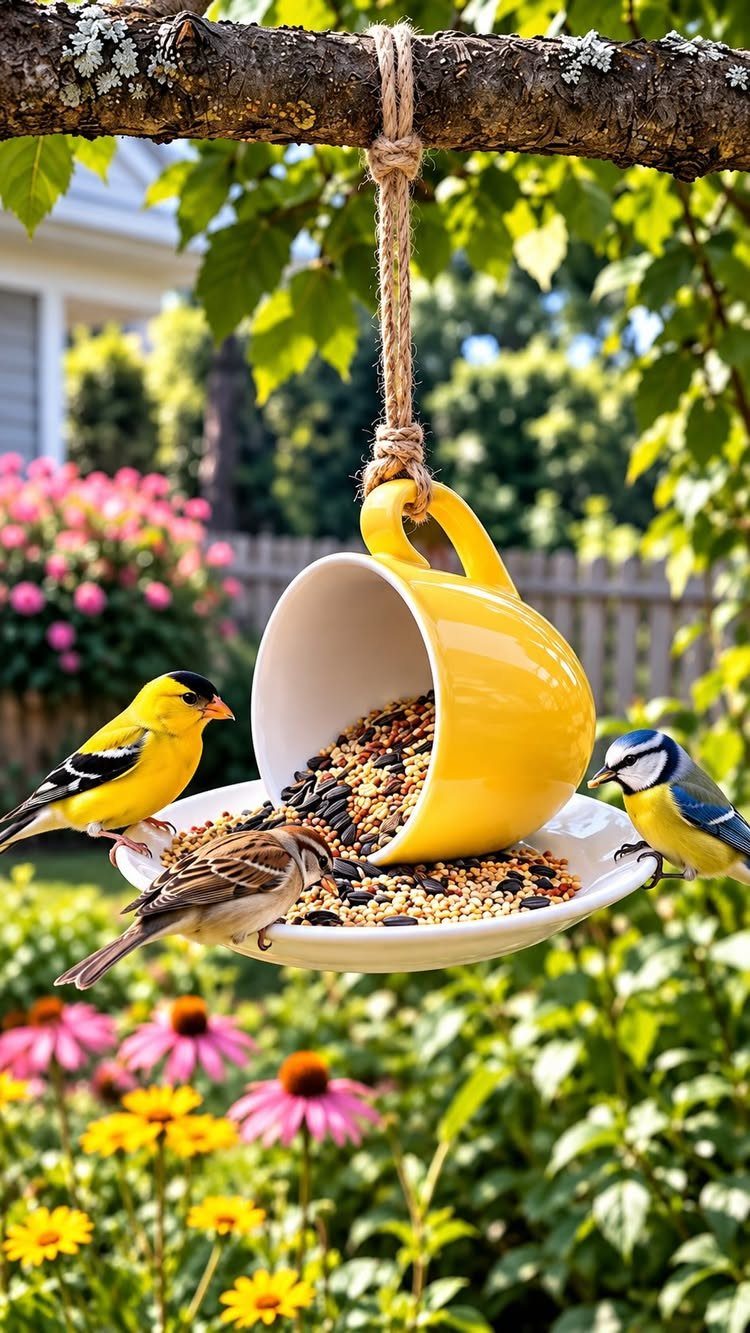
A teacup and saucer, glued and hung, turns a thrift-store cup into something a bird might actually visit.
Weight decides what you hang it with: a ceramic set this size needs a chain or coated wire, not twine, which rots and drops the whole thing in a season.
I would check that the cup drains; a hole drilled in the saucer keeps seed from molding after rain.
The yellow glaze is cheerful, but any color works if the finish is glossy enough to shed water. I would avoid delicate handles; they snap under torque when the cup swings.
8. Colorful Outdoor Chairs
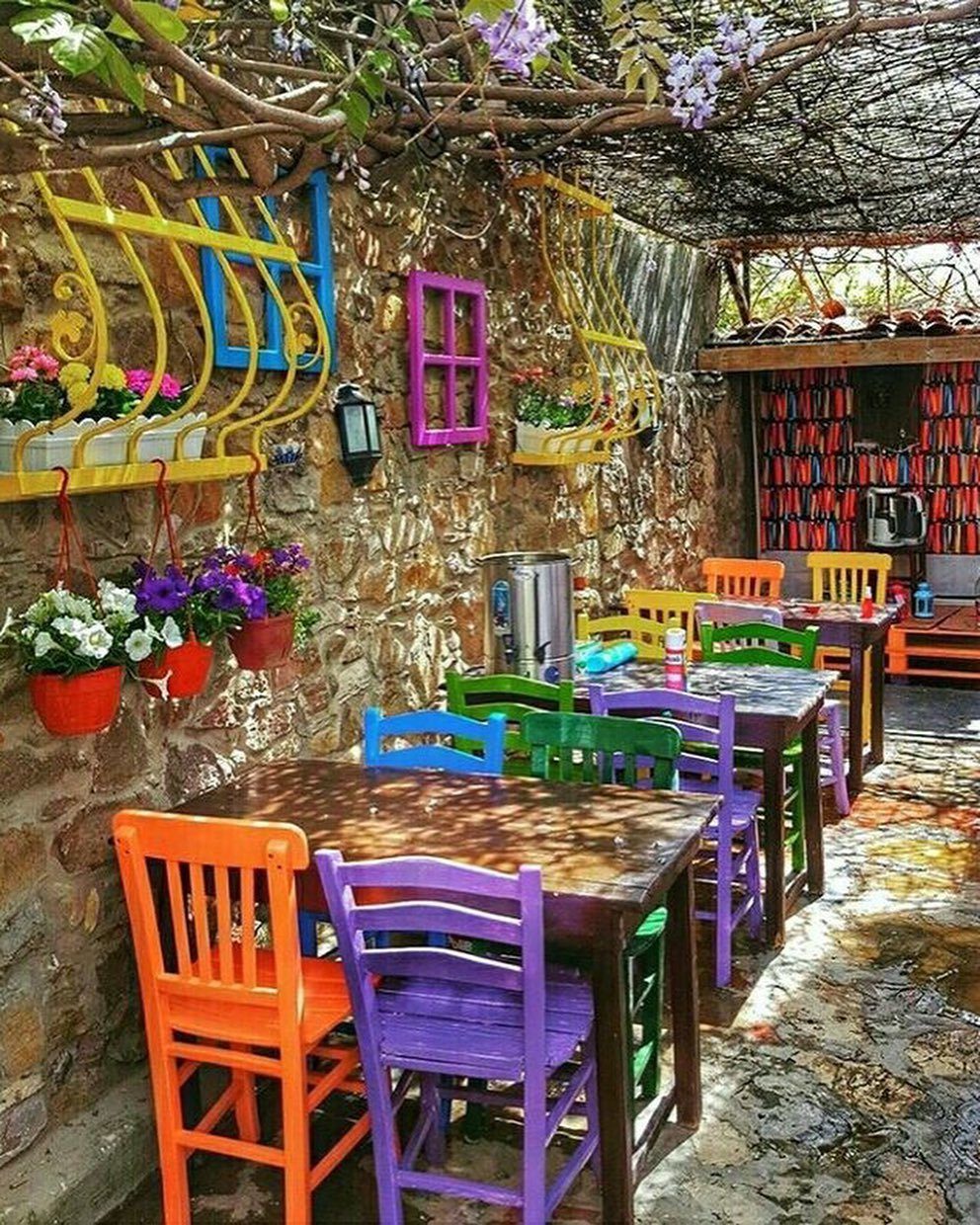
Painted chairs against stone walls work because the wall mutes the noise of multiple bright colors into something coherent.
The specific shades matter less than keeping them all at similar saturation; a pastelled chair among saturated ones would read as faded, not planned.
Exterior-grade acrylic latex over primer lasts longer on vertical chair backs than on horizontal seats in full sun, so the backs keep their color years after the seats start to show wear.
I would sand first; paint over weathered sealant flakes off in sheets.
The wood here looks like teak or acacia, which takes paint well but needs the grain filled or it shows through. Metal chairs go smoother but cost more and rattle in wind.
9. Add Water Features
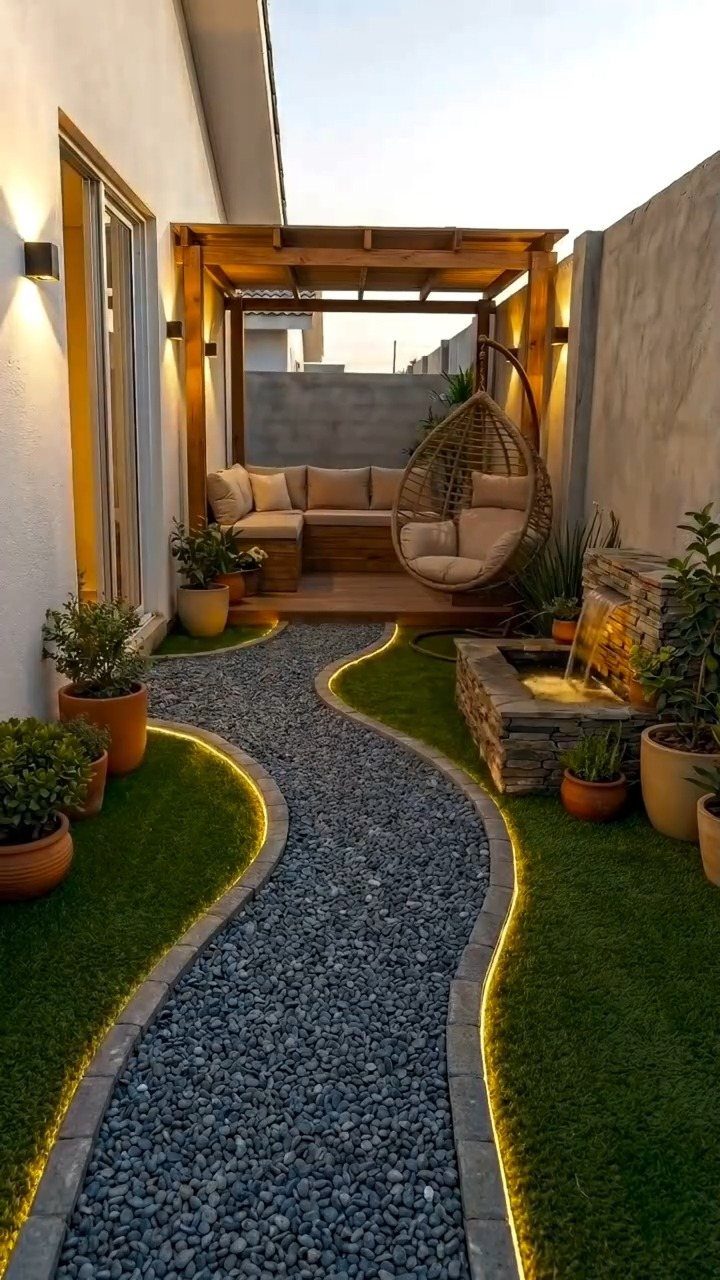
A waterfall built against a wall gives sound without the maintenance of a pond; no standing water means no mosquitoes, no algae bloom, no heron eating your fish.
Stacked stone works the same as carved if the edges are flat enough to sit level; a small submersible pump recirculates water from a hidden basin below.
LED strips along the path add visibility but need a GFCI outlet or solar converter rated for wet locations; standard outdoor plugs are not enough.
I would run the pump on a timer, not continuous; it saves electricity and lets you hear crickets when you actually want to. The artificial grass here is a choice, not a necessity; real lawn gets muddy against constant spray.
10. Mosaic Stepping Stones
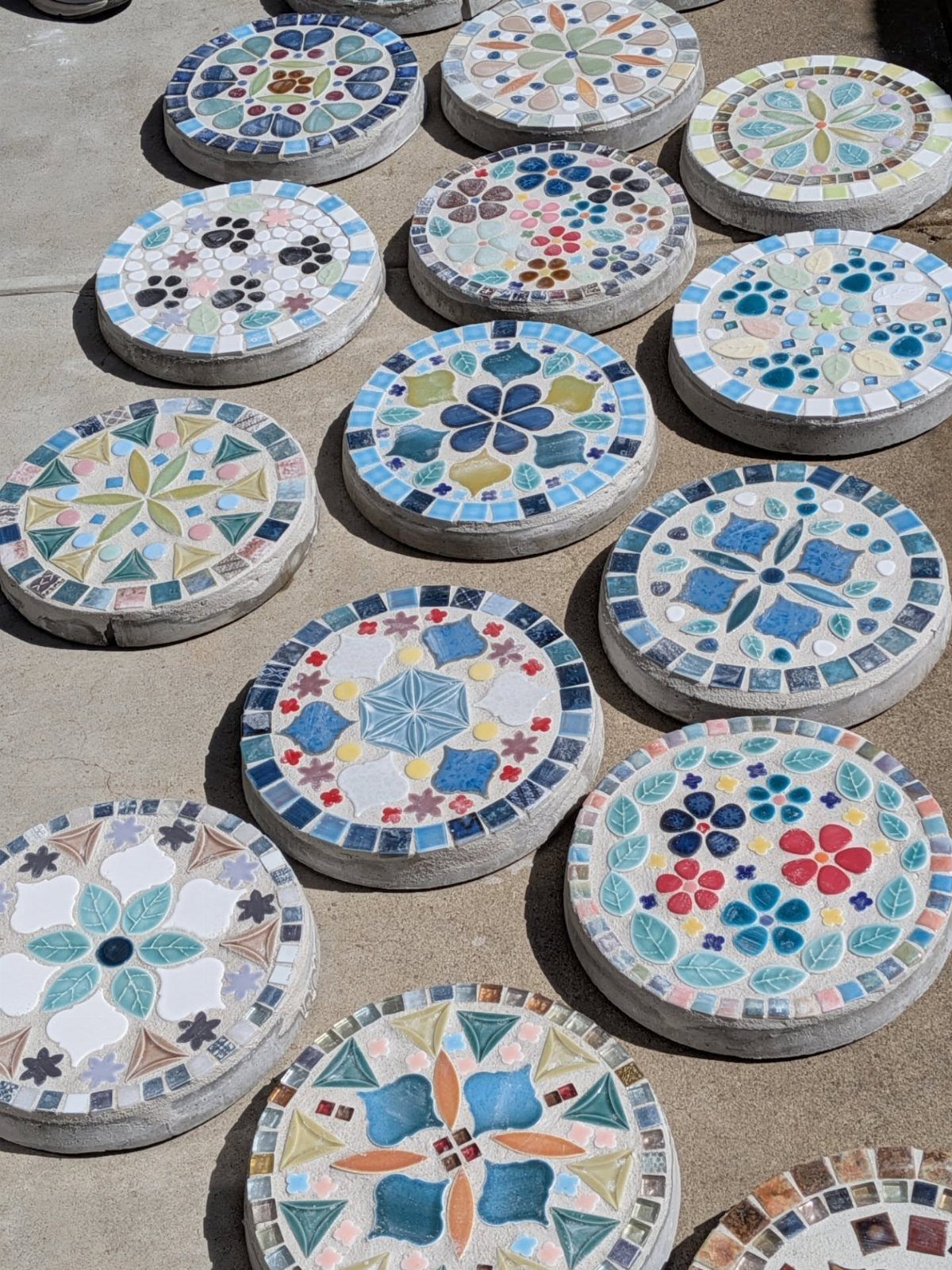
Mosaics on stepping stones let you use broken dishes or tile remnants that would otherwise landfill.
The surface needs to stay flat enough for safe footing; I would press tiles level with the grout line, not proud of it, or heels catch.
Concrete pavers take the mosaic best if they are cured 2 weeks first; fresh concrete alkalinity loosens grout. I would seal finished stones with a penetrating sealer, not a film, or the surface gets slick when wet.
A full set takes a weekend if the weather holds, though you will need to work in batches to fit the curing time for each stone.
11. Decorative Garden Stakes
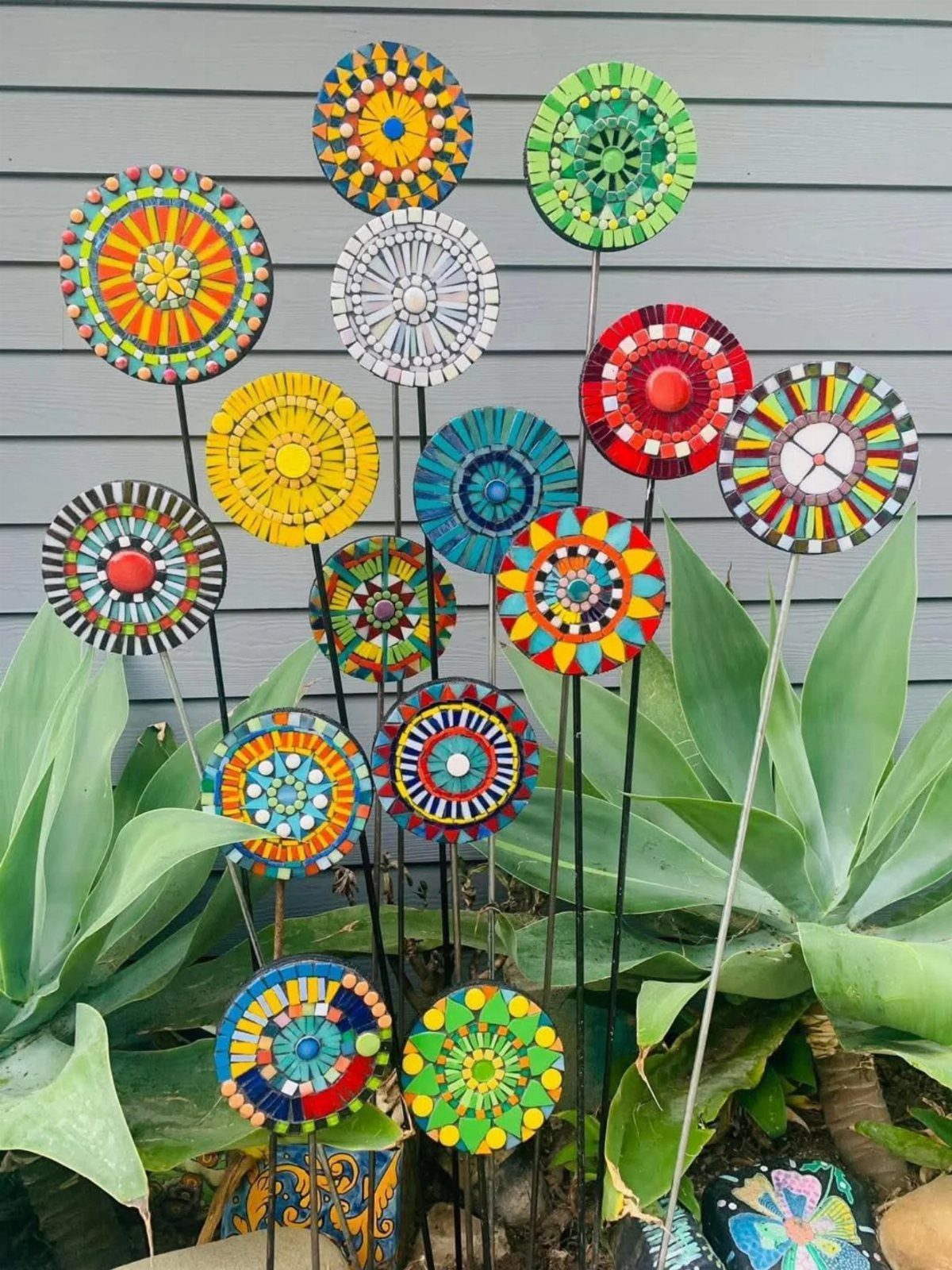
Stakes among succulents add height where the plants themselves stay low and wide.
The mosaic discs are small enough not to overwhelm the agaves behind them, which matters more than exact size when you are choosing stakes for a planted bed.
I would set stakes 18 inches minimum into the ground; wind leverage on a disc this size is higher than it looks. The metal rod needs to be galvanized or powder-coated, or rust bleeds up through the grout in a season.
Succulent beds need little water, but splash from automatic sprinklers still reaches these discs; I would check that the backer is exterior plywood or cement board, not MDF, which swells and delaminates.
12. Garden Animal Sculptures
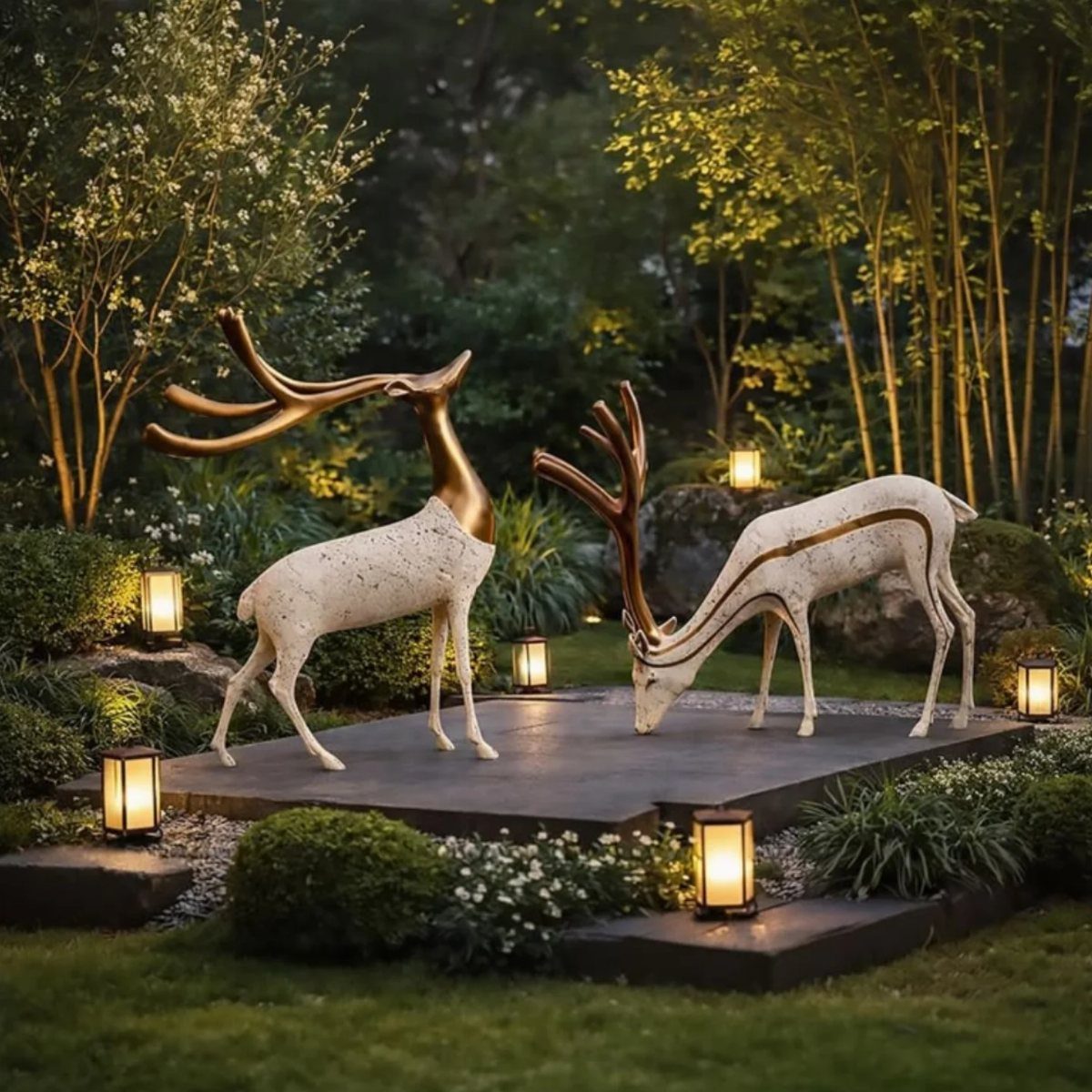
Ceramic deer on a stone platform read as garden art rather than lawn ornament because the platform lifts them into deliberate display.
The white glaze with gold line detail is formal; it suits an evening-lit space more than a casual daytime garden.
I would bring these inside for winter in zones where frost penetrates ceramic; the glaze crazes, water gets in, and the body cracks by spring.
The scale matters: 2 pieces this size need breathing room, or they look like escaped mantel decorations.
I would anchor them lightly with museum putty even on level stone; a raccoon or drunk guest can topple them, and ceramic repair never truly hides.
13. Upcycled Tire Garden Bench
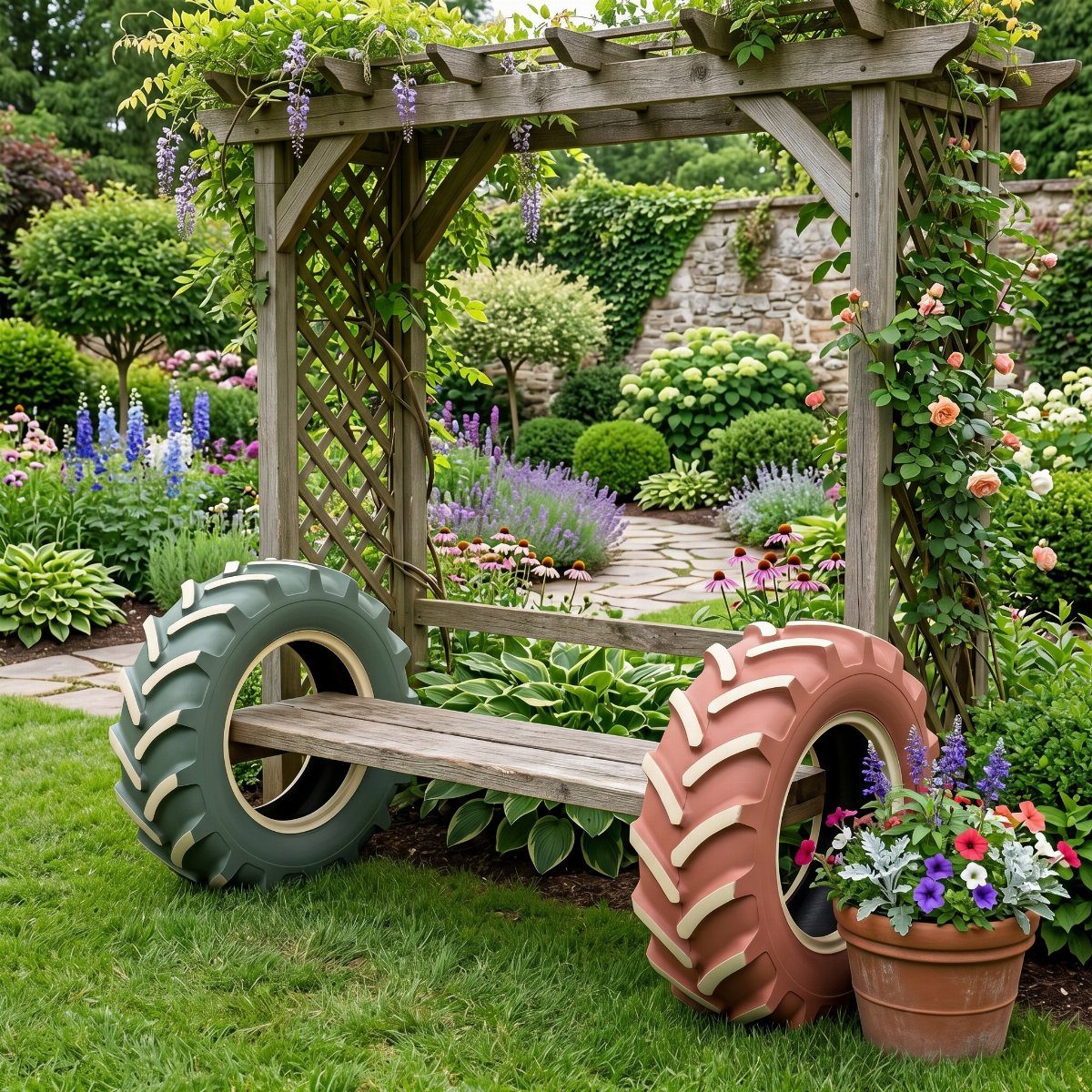
Two painted tractor tires and a plank make a bench that costs almost nothing if the tires come from a farm or shop you know.
The wood needs to span both tires with at least 6 inches of overhang on each side so the seat feels secure when someone sits near the edge.
Check that the tires match in height; a mismatch leaves the plank rocking. The paint here is exterior latex over primer, which hides the rubber smell and keeps the color from chalking.
I would bolt the plank through the tire sidewalls with lag screws and fender washers, not just rest it, or the whole thing shifts when someone leans back.
14. Vintage Door Garden Entryways
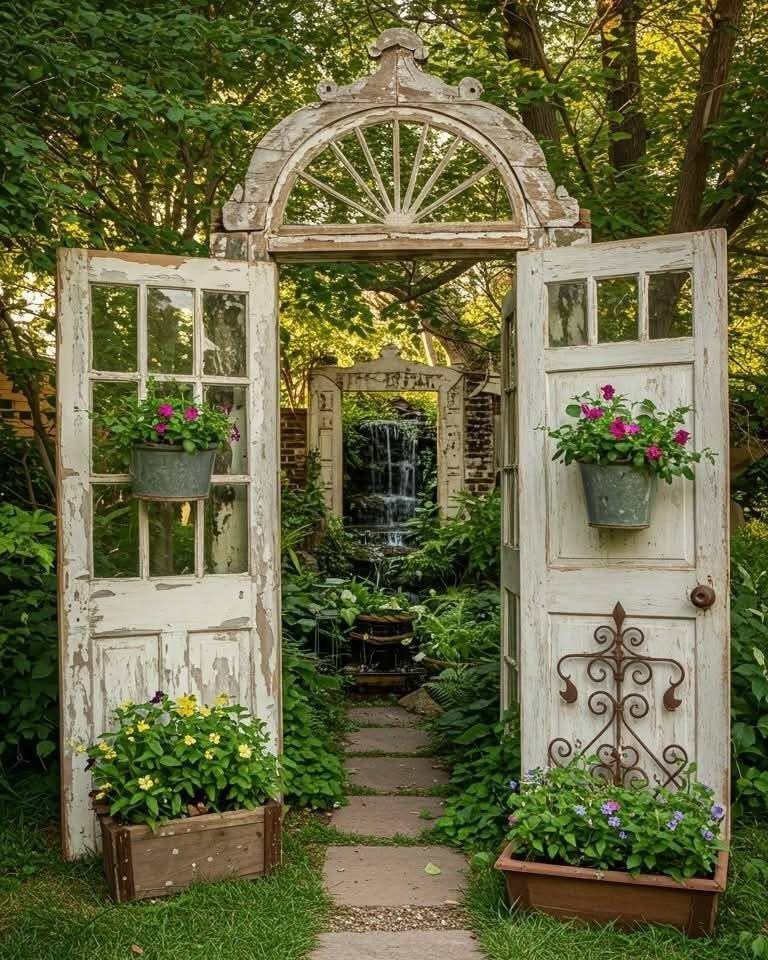
Old doors set as a freestanding arch turn an ordinary garden path into something that feels entered, not just walked. The doors do not need to open; they are scenery, so hinges are optional and often better left off.
What matters is the frame that holds them upright: 4×4 posts set 2 feet deep in concrete, or the first strong wind turns your entry into kindling.
The white distressed finish here is milk paint or a scrubbed latex, not actual neglect; real weathered wood softens and splinters.
I would hang planters on the frame, not the door panels, because seasonal wet soil warps old boards from behind.
15. Glowing Orb Pathway Lights
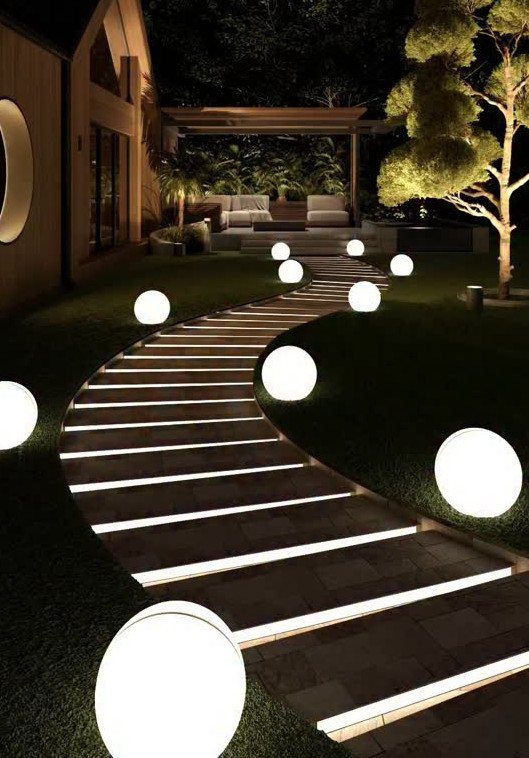
Orb lights along a stone stair read modern because the spheres spread light without a visible bulb; you see glow, not glare.
Solar orbs work only where the path gets direct sun during the day; shade from the stair risers or nearby trees leaves them dim by evening.
Wired low-voltage versions cost more but stay bright; I would run them on a transformer if this were my main route after dark.
Even spacing gives coverage without the runway look of rows too close together. The white globes here show dirt fast; a quick wipe with a damp cloth every few weeks keeps them from turning gray.
16. Hanging Wicker Globe Lanterns
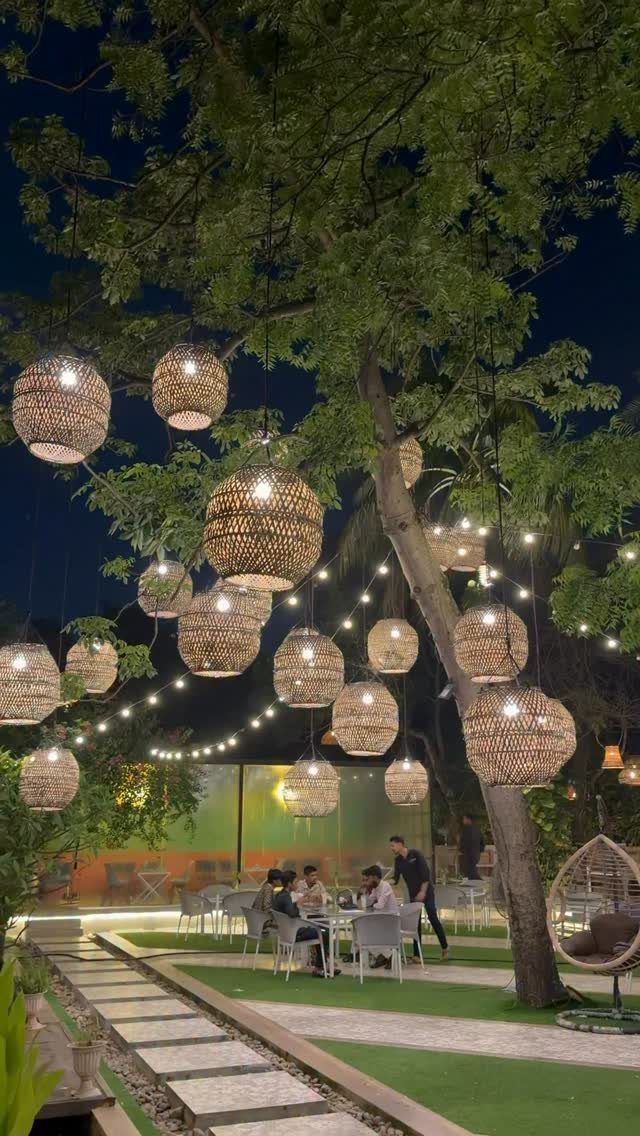
Wicker globe lanterns hung from branches give soft light from all angles, not the directional beam of a pendant or string bulb.
The weave material matters: natural rattan soaks up humidity and sags in southern summers, while resin wicker holds its shape but weighs more.
I would use S-hooks or carabiners rather than permanent knots, so I could lower them for cleaning or take them in before storms.
Bulb choice decides the mood; warm white 2700K LEDs feel like candlelight, while daylight 5000K reads clinical against garden darkness. The height here, roughly 8 feet, lets tall guests pass without ducking.
17. Colorful Tree-Mounted Birdhouses
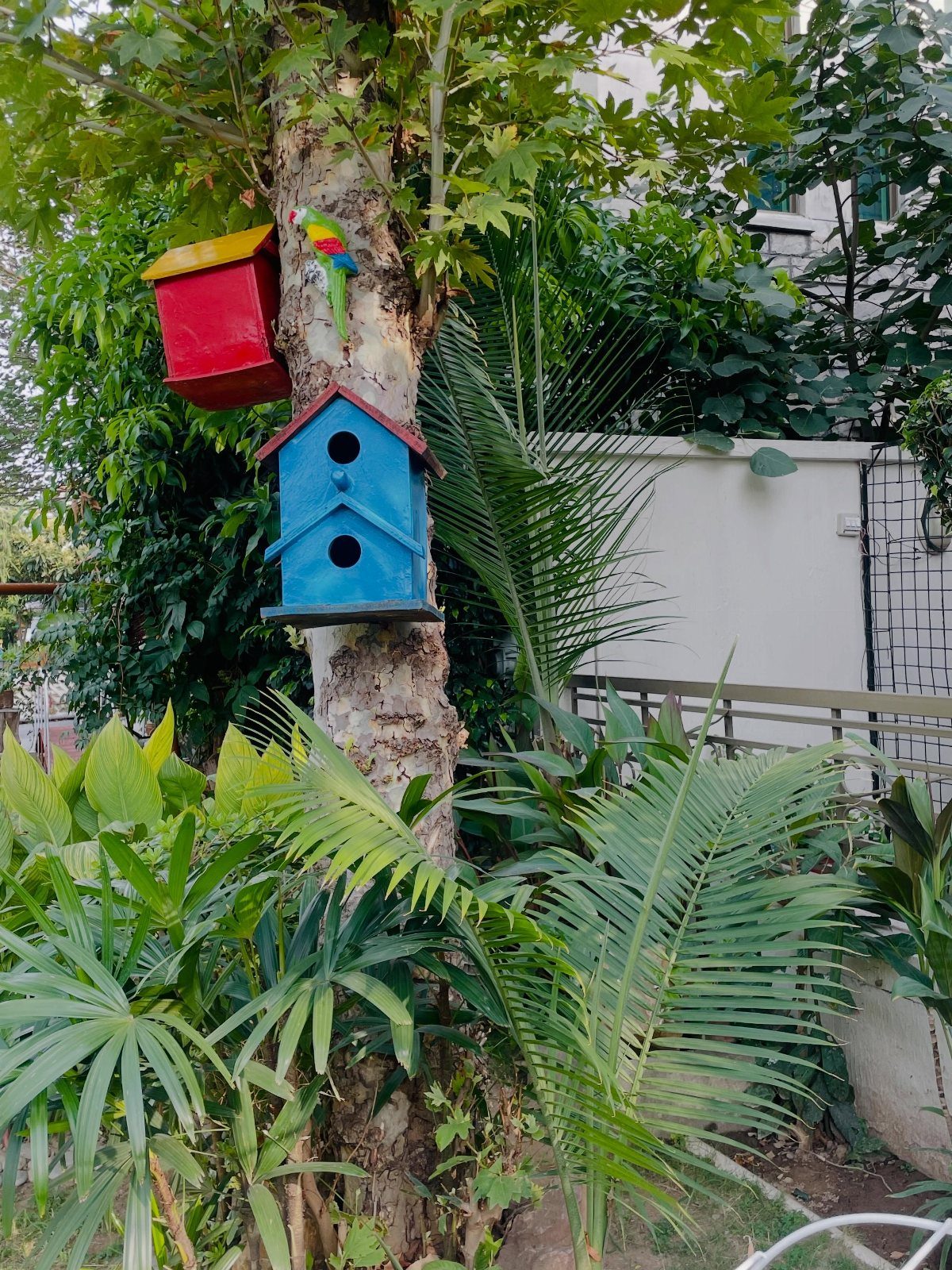
Bright birdhouses screwed to a trunk turn bark into architecture. The mounting hardware needs to be stainless or exterior-grade; standard screws rust and bleed orange streaks down the wood in a season.
I would pre-drill pilot holes slightly smaller than the screw shank, or the trunk’s expansion splits the birdhouse back.
Paint on outdoor birdhouses should be zero-VOC or left to cure weeks before mounting; fumes linger in enclosed cavities and can deter nesting.
The tropical setting here suggests these are decorative; in a climate with actual cold, I would add ventilation gaps and a cleanout panel, or they become squirrel housing by November.
18. Pattern-Casting Solar Lanterns
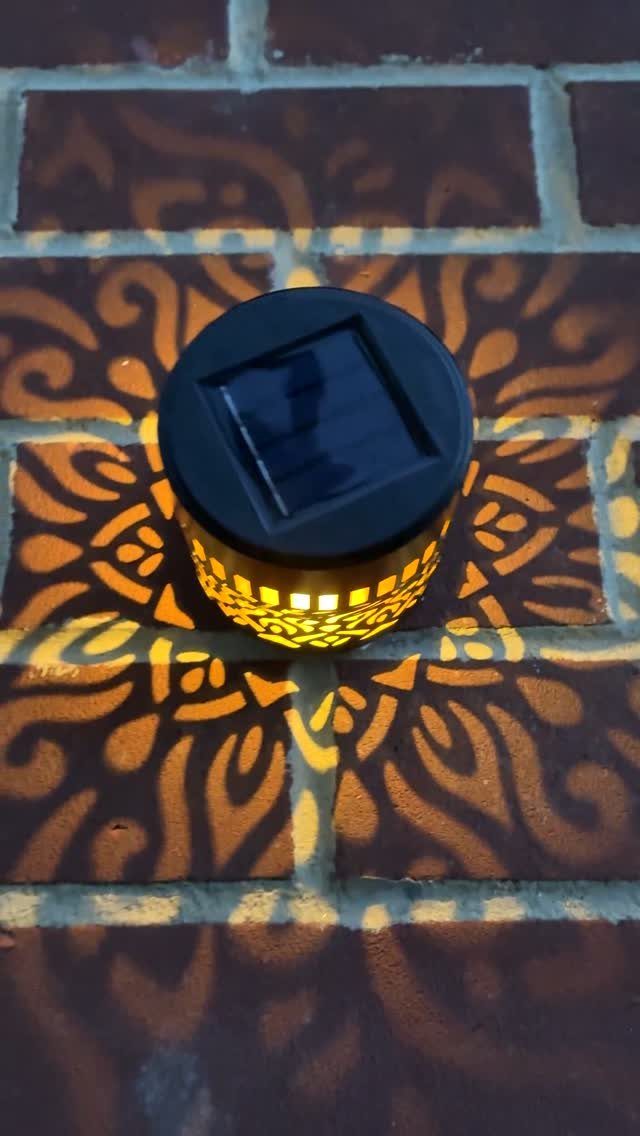
A solar lantern that throws patterns onto brick gives the ground itself something to look at after dark.
The effect depends on the surface: the smoother the pavers, the sharper the projection, and these bricks look wire-cut with enough texture to soften edges slightly.
Built-in solar means no wiring, but the panel needs sun; I would set it where the lantern catches direct light, not tucked under eaves. The mandala cutouts here cast radial swirls; geometric patterns read more modern, floral more cottage.
Runtime varies by battery and panel size, but figure 4–6 hours of real glow after a summer charge, less in winter. I would buy two and test placement before committing to a full set.
Choosing Durable Materials
Teak, powder-coated aluminum, and all-weather wicker are the 3 materials that hold up season after season in actual weather.
Powder-coated aluminum will not rust; the coating is baked on, not painted, so it does not chip the way standard paint does.
Teak lasts because its natural oils repel water; it grays like any wood left outside, but the structure stays sound for years.
All-weather wicker is resin, not plant fiber, which is why it survives humidity that rots natural rattan in a season.
The catch with teak is price; the catch with aluminum is weight in wind.
I would put my money into teak for surfaces people touch daily, aluminum for frames, and wicker only where it sits under cover or comes inside before storms.
A spray-on marine varnish can extend the life of less expensive pieces.
It builds a harder film than standard exterior polyurethane and stands up to UV longer. I would reapply every 2 years in full sun, every 3 in partial shade.
Lighting Techniques
Accent, downlighting, and path lighting serve 3 different purposes, and mixing them wrong wastes the effect.
Accent lighting belongs at ground level, aimed upward at a single plant or ornament; the beam needs to stay tight or it bleeds into general glare.
Downlighting hangs high in branches, pointing straight down through leaves to cast dappled shadow on paths or seating below. The fixture needs to be dark in color, not white, or it becomes the thing you notice.
Step lighting is one type where the fixture itself can stay visible, because its job is to prevent a stumble at a specific spot.
Path lights should stay low and spaced well apart along a walk; too close together reads like an airport runway.
Uplighting I would use sparingly.
A tree lit from below is dramatic for 10 minutes and then feels like a security measure. I would limit it to one specimen tree near a viewing spot, not every trunk in the yard.
Solar-powered fixtures work where the panel sees sun most of the day; I would wire anything needed for safety, like stair risers, because solar dims just when you need it most.
Coordinate fixture finishes with your house hardware, not necessarily matching, but in the same family. A black lantern on a brass porch light looks like you inherited both.
Creating Cohesive Designs
The garden should look like it belongs to the house, not like a separate project that happened later.
Stone cladding on the house means stone walls or paths in the garden; painted siding means painted wood or metal decor, not raw timber that clashes.
Scale is the part people miss. A two-story house needs urns and pedestals you can see from the street; a cottage gets overwhelmed by anything taller than shoulder height.
The iron urn and terra-cotta pedestal pairing in the entry works because both materials age similarly: iron rusts softly, terra-cotta effloresces, and neither looks wrong next to the other.
I would avoid mixing one pristine material with one deliberately aged; the contrast looks accidental.
A pediment as a succulent holder is a formal gesture in an informal planting. It works only if the plants inside stay tight and low; anything trailing or tall breaks the architectural line.
Repeat shapes as well as materials. If your windows have arches, echo them in a garden gate.
If your trim is flat and square, keep garden geometry crisp. The transition happens at the threshold; I would place the first matching element within 10 feet of the door, or the connection reads as coincidence, not intention.
Frequently Asked Questions
How to decorate outside of a house?
I match hardscaping to what the house already shows. Brick foundation gets brick edging; cedar siding gets cedar planters.
The eye reads the connection without thinking. Stone cladding on the house pairs with stone walls or paths outside; iron urns suit iron details in the entryway.
Scale matters more than matching exactly: a large house needs heavier pieces or the garden looks toy-like, while a small house gets overwhelmed by oversized ornaments.
I would walk the exterior with a tape measure before buying anything that stands more than 3 feet tall.
What are some cool accessories for my garden?
Mason jar lanterns with battery fairy lights, mosaic stepping stones from broken dishes, and weathered wood shelves made from fence boards all cost under a few hours and a few dollars each.
The accessories that last are the ones you build to survive your actual weather: polyester linens instead of cotton, coated wire instead of twine, exterior plywood instead of MDF.
I would rather have three handmade pieces that hold up than ten store-bought ones that fade or rot by fall.
What are some unique garden statues available?
A plinth does the same work for a garden figure that a frame does for a painting.
6 inches of elevation turns a lawn ornament into something you look at instead of past. Museum putty on the base stops raccoons or tipsy guests from turning your statue into a repair project.
How do I make my garden look good?
Define spaces so each area feels intentional: a dining zone under a pergola, a vignette against a wall, a path lit for safety.
Water adds sound that masks traffic without needing a pond; stacked stone against a wall with a hidden pump gives the effect with no mosquitoes or algae.
Color comes from painted chairs at similar saturation, striped linens, or bright birdhouses mounted on trunks, not from random bright objects scattered around.
I would start with one finished corner and build outward; half a good garden beats a whole yard of half-done ideas.





